Description
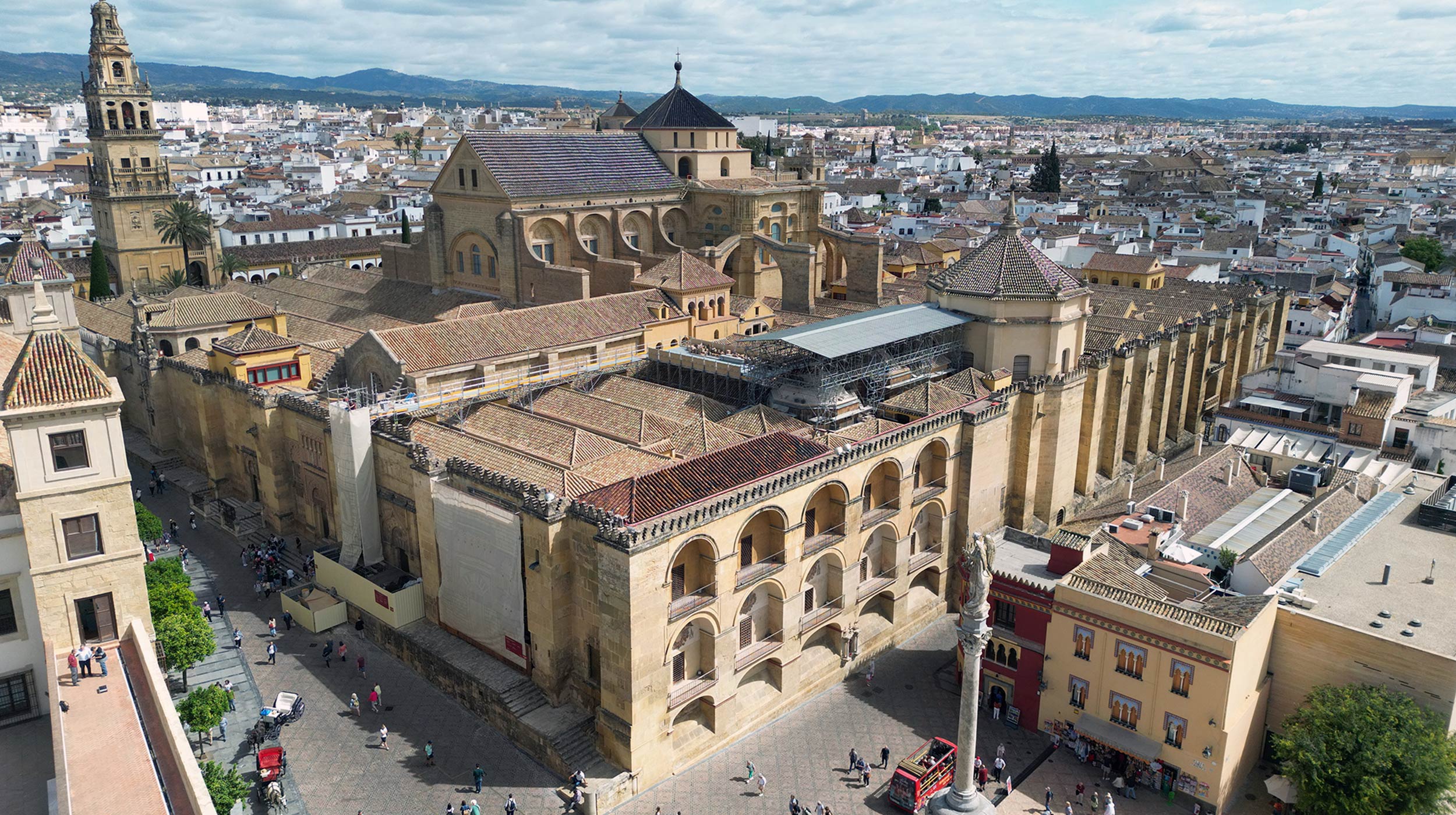
The maqsura of the Mosque-Cathedral of Córdoba is one of the city’s most fascinating architectural treasures. It is a reserved area within the main building, located on the southern side of the mihrab, which is the most sacred part of the mosque.
The Cathedral Chapter, responsible for the conservation of this monument since 1239, has always placed particular emphasis on preserving and restoring this space, aiming to return the maqsura and mihrab area to its original state.
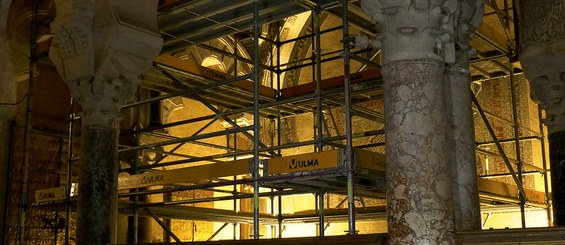
The restoration project, with an expected duration of around three years, will recover the original appearance of both the mihrab and the maqsura, using the same materials employed in their construction in the 10th century.
ULMA Solution
The project faces two significant challenges related to the lack of support points: their location and dimensions, which have had an influence on the design of the structures.
Handling the materials during assembly has been very labour-intensive, as it was necessary to move across the roof via 30 cm-wide walkways, hoist and transfer the pieces over the various roof levels, with the length of the beams limited to between 500 mm and 4 m.
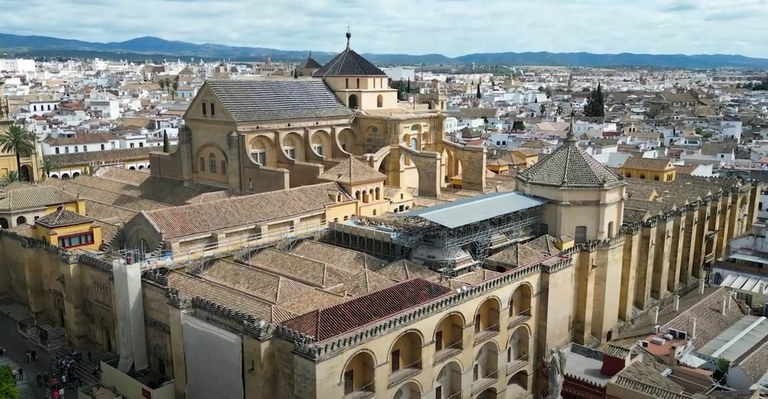
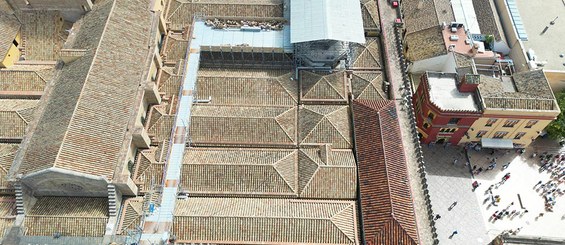
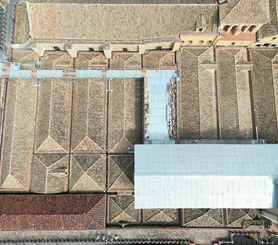
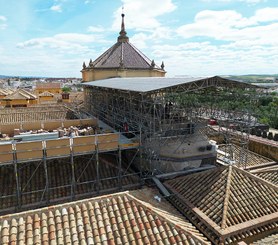
The work has been carried out in two distinct phases. In early 2016, the assembly of a protective temporary roof over the maqsura roofs began.
Eight years later, in January 2024, a walkway was installed to allow access from the exterior of the west-facing wall to the superstructure, serving both as an access route and for material storage. Both structures were constructed using BRIO multidirectional scaffolding.
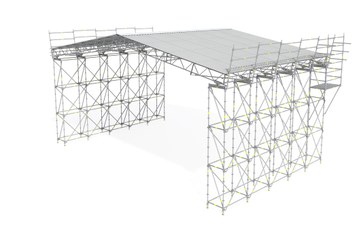
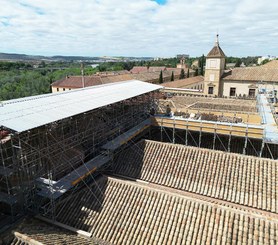
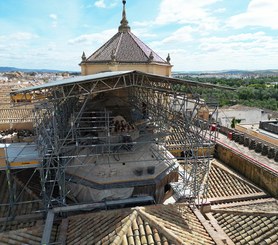
The temporary roof spans 7.5 m and is supported on longitudinal supports to clear the eaves of the octagonal maqsura roofs. Each support tower is anchored to the walls of the Mosque-Cathedral using a pair of inclined cables and push-pull props on either side. The pitched roof of the temporary roof is covered with metal sheeting, and longitudinal and transverse walkways are arranged around the three roofs.
The walkway consists of a structure formed by vertical posts reinforced with double supports, 500 mm beams, and diagonals in the form of struts, which pass over the ridges of the gable roofs. The frames are spaced 1.5 m apart to ensure a more even load distribution on the walls. The post supports rest on wooden planks placed on peripheral walkways along the top of the walls that support the roofs. Stop-ends with tubes and clamps, as well as chemical anchors into the walls, have been installed to prevent the structure from moving horizontally or lifting due to wind load.
The entire surface is covered with metal platforms and protected laterally by handrails and toeboards.
The walkway comprises a section along the wall with a length of 28 m and a width of 1.5 m, and a perpendicular section leading to the temporary roof with a length of 15 m and a width of 6 m.
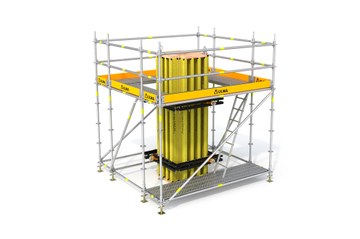
To remove debris from the roofs to the street, a 14 m-high BRIO tower was erected at the connection with the walkway on the west wall, to house a debris chute inside.