

Formwork Engineering for Floating Offshore Wind Energy
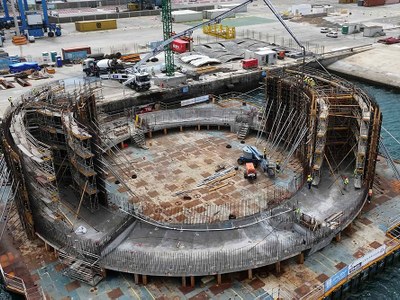
This technology enables wind turbines to be installed in offshore locations where water depth makes fixed foundations impractical. The prototype consists of two large concrete tanks connected by cables: an upper tank, 41 m in diameter, which provides buoyancy, and a lower tank, 14 m in diameter, which acts as ballast to stabilise the assembly. A framework above the floating platform supports the wind turbine tower.
Construction takes place vertically on a floating barge. This approach, together with the demanding tolerances and unusual shapes involved, has required extensive engineering work and careful planning to maximise equipment reuse throughout the different stages.
Engineering and Tailor-Made Formwork
Collaboration between ULMA and the client began before work started on site, with the analysis and development of the formwork systems. The main challenges included the curved base slab, circular walls approximately 8 m high that had to be cast in a single pour, and numerous projecting elements with intricate geometries.
To address these requirements, ULMA has combined standard equipment with specially designed components. The upper tank walls were constructed using adjustable circular formwork alongside the ORMA Modular Formwork System. This arrangement achieved the required curvature while minimising the need for purpose-made elements. The work was divided into six 60-degree sectors, which facilitated the relocation and reuse of most panels across successive concrete pours.
The upper tank base slab was completed in three 120-degree sectors using an ENKOFORM configuration with specially manufactured curved walers. Expanded polystyrene elements were incorporated as permanent formwork in the central area. This design simplified assembly and dismantling and allowed the reusable components to be recovered for subsequent stages.
Other distinctive features of the prototype called for individual engineering solutions. Specially machined timber moulds were developed for certain anchoring points intended to moor the platform at sea, based on techniques traditionally used in foundry pattern-making.
Custom steel moulds were also manufactured to produce the precast slabs forming part of the upper tank roof. These elements subsequently serve as permanent formwork for the in-situ concrete topping that completes the roof.
The BRIO Multidirectional Scaffolding System provided access and working platforms suited to the different areas and successive phases of the project.
ULMA used Revit® and BIM methodology to develop the formwork designs based on the 3D model supplied by the project engineering team. This approach helped identify potential clashes, define assembly details and provide site teams with the information required for accurate installation.
The integration of engineering expertise, digital tools and purpose-designed equipment has been essential to meet the project's technical requirements, particularly in terms of installation precision, adaptation to challenging geometries and material reuse.
Once assembly is complete, the prototype will be towed offshore and installed off the coast of Gran Canaria, where it is expected to remain for ten years as part of the development of this floating offshore wind energy technology.
Find out all the details of the project in this video.


